Why we stopped plating anything
Plating hides the metal and fails first. What happens when you let brass age instead.
We spent our first decade repairing other people's hardware, and the single most common job was not a broken mechanism. It was a finish that had failed and taken the look of the object down with it. (This article is part of our complete guide to caring for solid brass.)
What plating actually is
Plating is a coat of one metal deposited over another — usually a few microns of nickel, chrome or "antique brass" over a cheaper base. It is not a colour. It is a separate layer with its own thickness, its own hardness, and its own edges.
Edges are the problem. Wherever a plated surface is worn, struck or flexed, the layer breaks and the base metal underneath is exposed. Now you have two metals in contact with moisture, which is a galvanic cell, which means the base corrodes faster than it would have on its own. A plated handle does not gently age. It goes patchy, then blotchy, then it lifts.
Lacquer does the same thing more slowly. It yellows first, then crazes, then peels in flakes, and the tarnish it was supposed to prevent forms underneath it where you cannot reach it. Stripping old lacquer off a sconce is a solvent job that takes longer than making the part.
What we found in the buildings around us
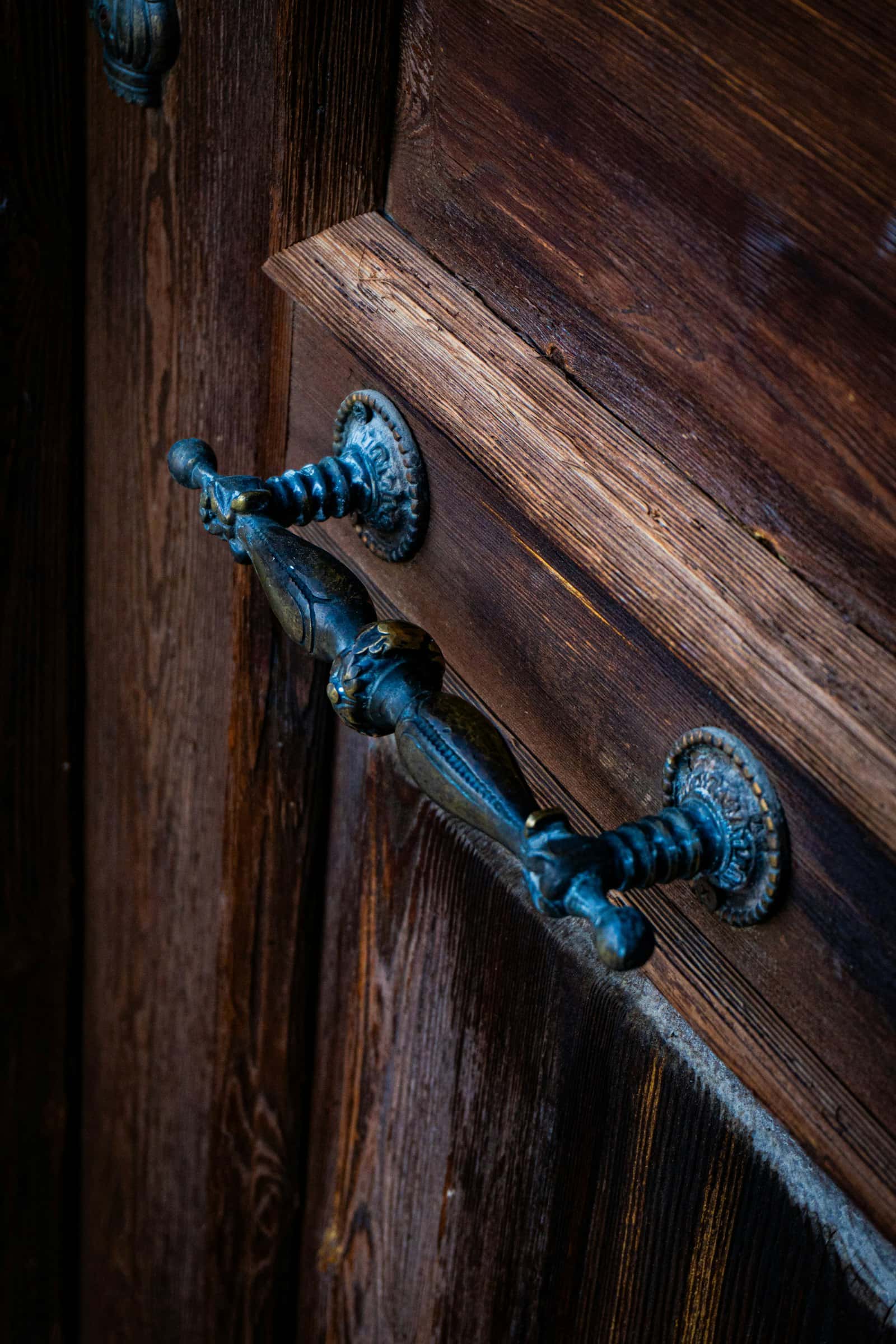
The hardware still worth repairing after ninety years was almost always unplated and unlacquered. Solid brass espagnolette bolts. Bronze casement stays. Cast handles that had gone a deep chocolate brown where nobody touched them and stayed bright gold where thumbs had passed for three generations.
None of it had been maintained. That is the point. It had simply been left to reach a stable state and then left alone.
The trade
So we do not plate and we do not lacquer, and there are two things you give up for it.
The first is uniformity. A bare brass door pull in a hallway will not look identical to the one at the far end, because they get touched differently. If matching matters more to you than ageing, we are the wrong workshop.
The second is the ability to freeze the object at the moment you bought it. Bare metal moves. Within a few weeks it will have shifted; within a year it will be a different colour than the photograph — we wrote down the whole twelve-month patina timeline so you know what to expect.
What you get back is a piece that has no failure mode at the surface. It cannot flake, because there is nothing on it to flake. It cannot craze. The worst thing that can happen is that it gets darker than you like, and the fix for that is a cloth and five minutes.
If you want it bright
Polish it. There is no ritual to protect and nothing you can ruin. Use a mild brass polish sparingly, work along the direction of the finish rather than in circles, and buff every trace of it off — polish left in a corner keeps working and leaves a pale halo around the detail.
If you want the movement slowed without stopping it, a thin coat of microcrystalline wax buffed to nothing will hold the colour for six months or so. It is what museums use on bronze. It does not yellow and it comes off with white spirit when you have had enough of it.
And if you want to do nothing at all, that is the option we designed for.
The same reasoning applies to every metal we work — if you are unsure which one you have, start with the difference between brass, bronze and copper.
Questions people ask
- Is brass plating bad?
- Plating is a few microns of metal over a cheaper base. It looks the same as solid brass when new, but it wears through at edges and touch points, and the exposed base metal then corrodes. Solid brass has no layer to wear through.
- Should I remove the lacquer from old brass?
- If the lacquer is already yellowed or peeling, yes — the tarnish under it cannot be cleaned until it is gone. Strip it with a solvent-based lacquer remover, rinse, dry, and then decide whether to leave the brass bare or wax it.
- How do I stop unlacquered brass from tarnishing?
- You can slow it rather than stop it: a thin coat of microcrystalline wax buffed to nothing holds the colour for around six months, and it comes off with white spirit.
- brass
- finishes
- patina