Anatomy of a forged bowl
Nine steps from a flat disc to a finished piece, and the one we still do wrong.

A raised bowl begins as a flat disc and ends as a hollow form, and nothing is removed along the way. The metal is not carved or spun. It is moved. Raising is one of the oldest techniques in Moroccan metalwork, and it is how every bowl in our range is made.
The nine steps
- Cut the disc. For bowl no. 4 that is a 300 mm circle of 1.5 mm brass, sheared and then filed true. A disc that is out of round stays out of round.
- Anneal. Heat to a dull red and quench. Brass work-hardens as you hit it; annealing puts it back to soft. You will do this between every course.
- Course one. Working from the centre outward over a stake, hammering the metal down against the steel in overlapping rings. The disc begins to dish.
- Anneal again. By the end of a course the metal rings differently under the hammer. That change in sound is the cue, not the clock.
- Courses two and three. The wall comes up. This is where the diameter shrinks and the height appears, and where a bowl either stays symmetrical or does not.
- True the rim. Scribe a line, cut back to it, file the edge square. Roughly 15 mm of the original disc is lost here.
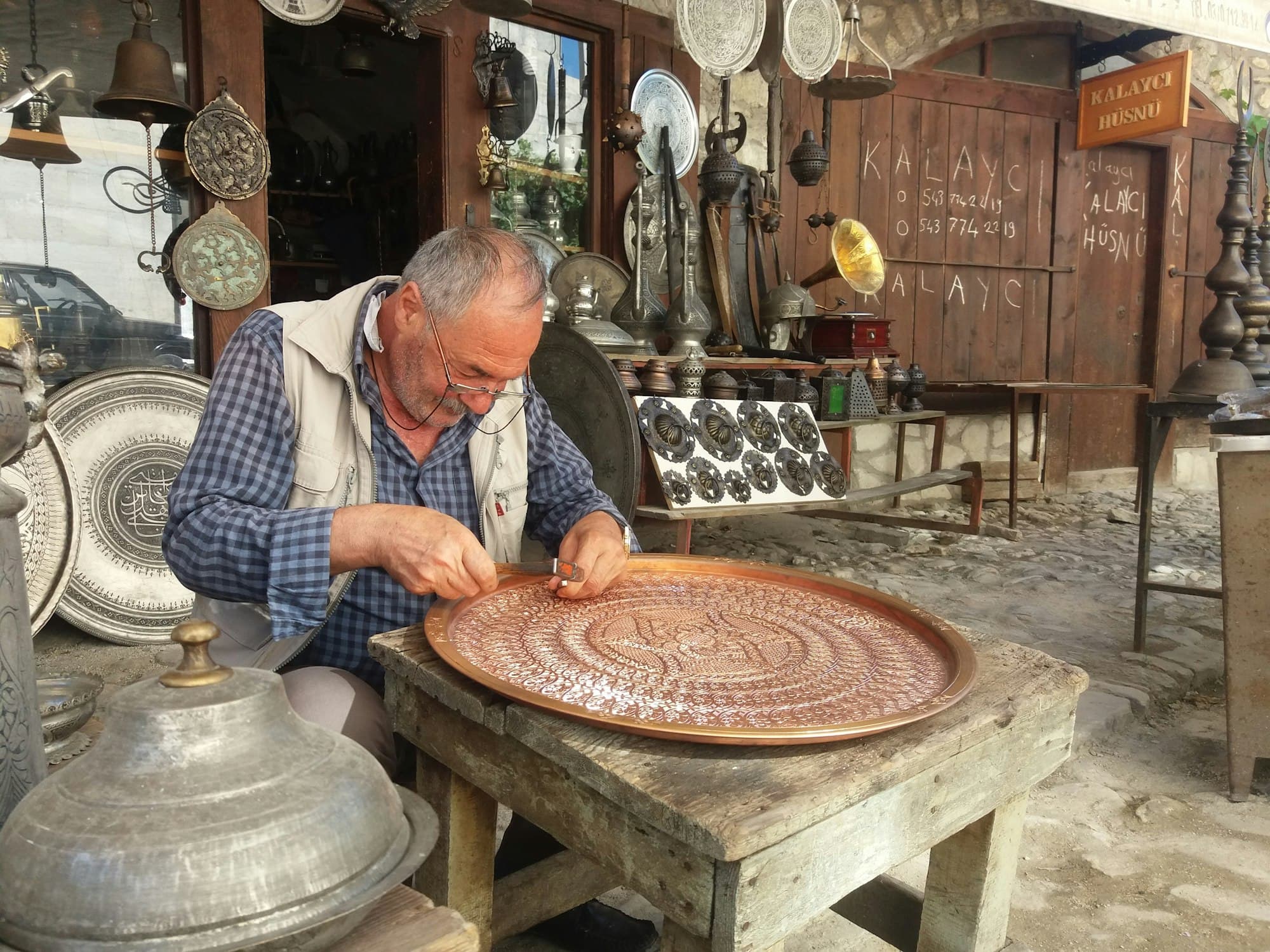
- Planish. A polished hammer against a polished stake, overlapping strikes across the whole surface. This is what compacts the metal, removes the coarse marks and gives the finished piece its texture.
- Level the base. A slight foot, tapped in from below, so the bowl sits without rocking on a table that is itself not flat.
- Wax. Clean, dry, a thin coat of microcrystalline wax, buffed off. From here on it is yours to age — see living with a patina.
Four heats, about five hours, across two days because the annealing wants time.
Where the character comes from
The wall thickness varies. It has to — you are moving metal from the centre towards the rim, and no hand does that perfectly evenly. A spun bowl is uniform to a hundredth of a millimetre and it feels like nothing in the hand. A raised bowl is thicker at the base than at the lip, which is exactly what your hand expects from a vessel and never gets from a machine-made one.
The planishing marks are the other half. They are not decoration. They are the record of the last course of hammering, and they catch light at a hundred slightly different angles, which is why the surface changes as you walk past it. It is also why we planish only under a north-facing window.
The step we still do wrong
Step 6, truing the rim.
Cutting back to a scribed line is straightforward. Getting the rim to sit in a single flat plane afterwards is not, and after twenty-five years I still put a bowl on the surface plate and find one quadrant sitting two tenths of a millimetre proud.
The honest answer is that a raised form is under uneven stress and it moves after you cut it. You can chase that error around the rim for an hour. You can also accept two tenths, which is invisible to the eye and detectable only by someone with a straightedge and a grievance.
We accept it. Every bowl that leaves here has a rim that is very slightly not flat, and I have decided to describe that as the difference between our bowls and a machine's rather than as the defect it technically is.
Questions people ask
- What is the difference between a raised bowl and a spun bowl?
- A spun bowl is pressed over a form on a lathe and has an even wall. A raised bowl is hammered up from a flat disc by hand, so the wall varies in thickness and the surface keeps the hammer marks from planishing.
- Why does brass need annealing while it is hammered?
- Brass work-hardens as it is struck and eventually cracks. Heating it to a dull red and quenching it makes it soft again, so a bowl is annealed between every course of hammering.
- process
- raising
- brass